



Some periods are defined by a single project.
Others demonstrate what can be achieved when an entire team comes together.
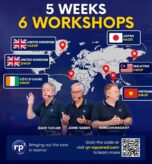
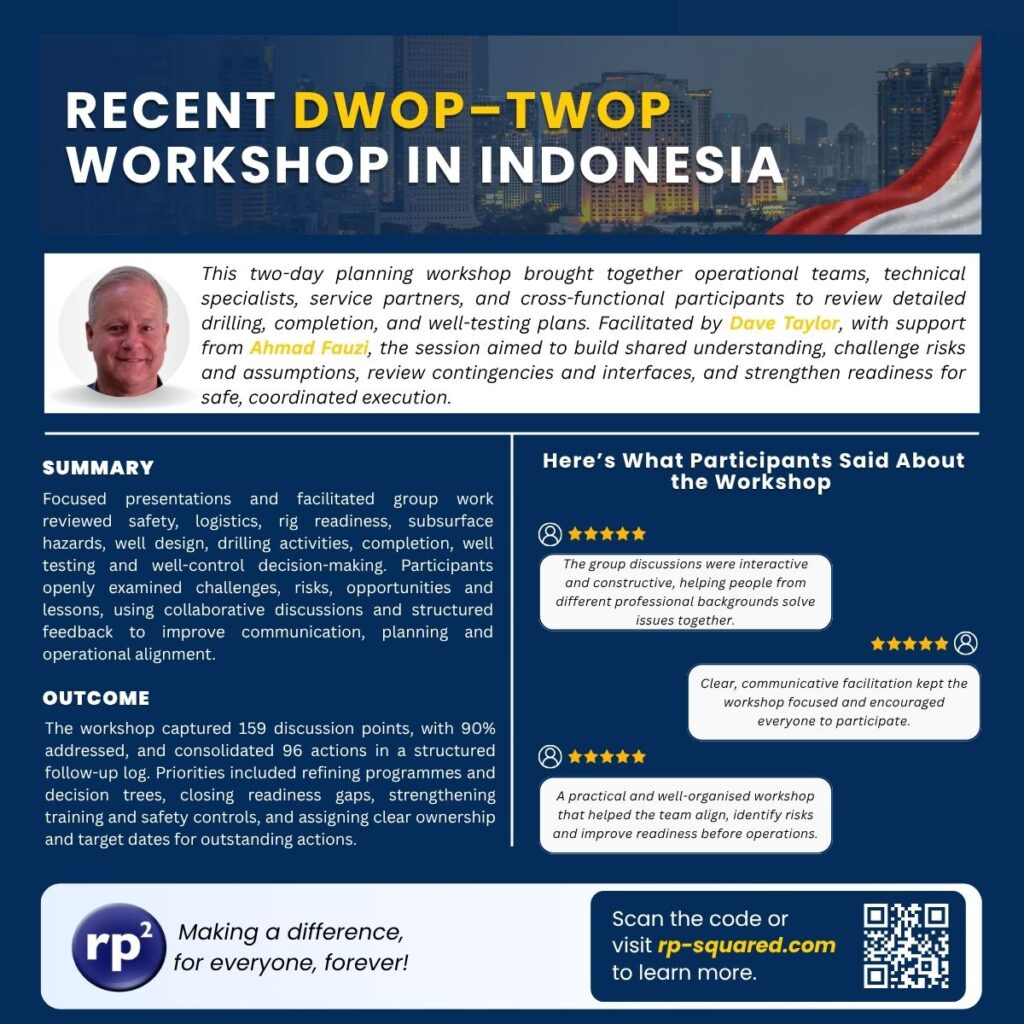
Over a five-week period, rp² delivered six workshops across five countries, supporting teams in the United Kingdom, Côte d’Ivoire, Japan, Malaysia, and Vietnam.
The programme included a combination of DWOP, HAZID, and HAZOP workshops, each designed around different operational requirements but united by a common purpose: bringing people together to improve understanding, challenge plans, identify risks, and strengthen readiness for execution.
At the centre of the delivery were rp² facilitators Dave Taylor, John Sands, and Duncan Mackay, supported by the wider team working behind the scenes.
Six Workshops Across Five Countries
The five-week programme included:
- United Kingdom – HAZOP
- United Kingdom – DWOP
- Côte d’Ivoire – DWOP
- Japan – HAZID
- Malaysia – DWOP
- Vietnam – DWOP
Each location brought a different operational context, different participants, and different technical challenges.
That means every workshop required more than simply following a standard agenda.
Facilitators needed to understand the objectives of each session, engage with the people involved, guide technical discussions, and help participants translate those discussions into meaningful outcomes.
Different Workshops, A Common Objective
DWOP, HAZID, and HAZOP workshops serve different purposes.
A DWOP — Drilling the Well on Paper — workshop helps operational and technical teams work through the planned well before execution. It creates an environment where participants can challenge assumptions, examine interfaces, identify potential issues, and improve coordination.
A HAZID — Hazard Identification — workshop focuses on recognising potential hazards and understanding the risks that may exist within a planned operation or activity.
A HAZOP — Hazard and Operability Study — workshop provides a structured process for examining how systems or operations may deviate from their intended design and what consequences those deviations could create.
Although the methodologies differ, they share an important principle:
better conversations before execution can support better decisions during execution.
Facilitation Is More Than Running a Meeting
Technical workshops can involve large amounts of information, multiple disciplines, competing priorities, and participants with very different areas of expertise.
The facilitator’s role is therefore much broader than managing an agenda.
Effective facilitation requires the ability to keep conversations focused while still allowing technical issues to be explored properly.
It means asking the right questions.
It means encouraging contributions from different disciplines.
It means recognising when an assumption needs to be challenged.
And importantly, it means ensuring that valuable discussions lead to clearly understood outcomes.
Across the six workshops, rp² facilitators Dave Taylor, John Sands, and Duncan Mackay helped guide teams through these complex discussions while maintaining focus on the objectives of each session.
The Work Behind the Workshop
A successful workshop rarely begins when participants enter the room.
There is significant preparation behind every session.
Travel needs to be coordinated.
Workshop materials must be prepared.
Technical information needs to be reviewed.
Stakeholders need to be aligned.
Schedules must be managed.
Participants need to understand the objectives.
And throughout the process, the wider team must continue supporting delivery.
That makes a five-week programme spanning multiple countries as much a story about teamwork and coordination as it is about technical facilitation.
While facilitators may be the people visible in the workshop room, successful delivery depends on the collective effort of everyone supporting the programme.
Working Across Different Operational Environments
Delivering workshops internationally also means adapting to different operational environments.
The challenges faced by a team preparing for activity in the United Kingdom may differ from those being discussed in Côte d’Ivoire, Japan, Malaysia, or Vietnam.
Local conditions, operational objectives, stakeholder structures, and technical requirements can all change.
The value of a structured workshop process is that it provides a framework while still allowing discussions to remain relevant to the specific operation.
That balance between structure and adaptability is central to effective technical facilitation.
Bringing People Together
One of the greatest strengths of workshops such as DWOP, HAZID, and HAZOP is their ability to bring multiple perspectives into the same conversation.
Operations teams bring practical execution experience.
Engineers provide technical insight.
Service companies contribute specialist knowledge.
Project teams understand broader objectives and constraints.
When these perspectives are discussed together, teams can identify issues that may not be visible when each discipline works independently.
The result is more than technical documentation.
It is a stronger shared understanding of the operation and the people responsible for delivering it.
Five Weeks. Six Workshops. One Team.
Delivering six workshops across five countries in five weeks required energy, preparation, flexibility, and strong collaboration.
A huge thank you to Dave Taylor, John Sands, and Duncan Mackay for leading the workshop delivery, and to everyone behind the scenes who supported each session.
Different countries.
Different teams.
Different operational challenges.
But throughout the five weeks, one thing remained constant:
one team working together to bring out the best in everyone involved.
That is another example of rp²’s Relentless Pursuit of Perfection.