



Successful operations depend on more than having a technically sound plan.
They require teams to understand that plan, challenge assumptions, identify potential conflicts, prepare contingencies, and align around how the operation will actually be executed.
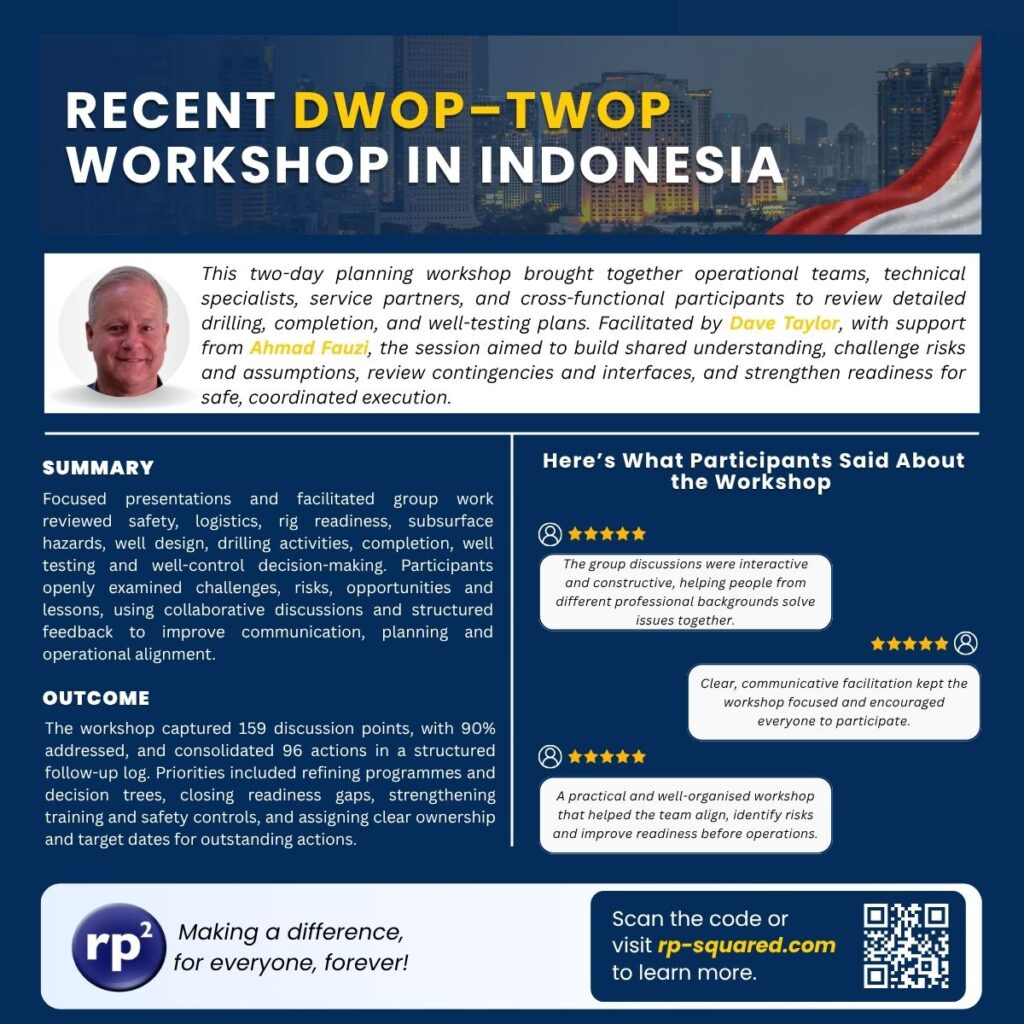
That was the focus of a recent DWOP–TWOP Workshop in Indonesia, where operational teams, technical specialists, service partners, and cross-functional participants came together for two days of structured discussion and operational preparation.
Facilitated by rp²’s Dave Taylor, with support from National Co-Facilitator Ahmad Fauzi and Intern Yesha Trixie Triyana, the workshop focused on strengthening shared understanding across the teams involved in drilling, completion, and well-testing activities.
Creating Alignment Before Execution
A Drilling and Well on Paper workshop provides teams with an opportunity to walk through an operation before it happens in the field.
The objective is not simply to review documentation.
It is to test the plan through discussion.
By bringing together the people responsible for different parts of the operation, teams can identify where assumptions differ, where interfaces require clarification, and where additional preparation may be needed.
This creates a stronger connection between planning and execution.
Instead of individual teams working from separate perspectives, the workshop provides a common environment where everyone can develop a shared understanding of the operation.
Reviewing the Complete Well Delivery Plan
The Indonesia workshop covered a wide range of technical and operational topics.
Discussions included:
- safety and operational readiness
- logistics and materials planning
- rig readiness
- subsurface hazards
- well design
- well control
- operational risks
- contingency planning
- drilling, completion, and well-testing interfaces
- lessons learned from previous operations
Each topic was considered in relation to the wider operation rather than as an isolated activity.
This cross-functional approach is important because issues during execution often occur at the interfaces between teams, disciplines, contractors, and operational phases.
Understanding those interfaces before operations begin can help teams reduce uncertainty and improve coordination.
Strengthening Safety Through Preparation
Safety remained central throughout the workshop.
Participants reviewed potential hazards, operating conditions, well-control considerations, and the contingencies required should conditions differ from the original plan.
Effective preparation means asking difficult questions before the operation begins.
What could change?
Where are the highest-risk interfaces?
What happens if the original plan cannot be followed?
Who needs to make the decision?
What resources need to be available?
Discussing these questions in advance helps teams move from reactive problem-solving toward more deliberate and coordinated decision-making.
From Discussion to Action
One of the key outcomes of the workshop was the volume of structured operational feedback captured during the two days.
In total:
159 discussion points were captured.
90% were addressed during the workshop.
96 action items were consolidated for follow-up.
These figures demonstrate an important principle of effective technical facilitation: discussion should result in action.
Workshops create value when observations and concerns are transformed into clear responsibilities, priorities, and follow-up activities.
The consolidated actions provide teams with a structured pathway for addressing remaining issues before execution.
The Value of Cross-Functional Participation
Complex well operations involve many different disciplines.
Drilling teams may focus on execution.
Subsurface teams may focus on formation conditions and geological uncertainty.
Logistics teams consider equipment and material availability.
Service partners bring specialist technical knowledge.
Completion and well-testing teams focus on later stages of the well lifecycle.
Bringing these perspectives together allows the operation to be considered as a connected system rather than a sequence of isolated activities.
It also gives participants the opportunity to understand how decisions in one area may affect another.
This shared understanding can be particularly valuable during execution, when teams may need to respond quickly to changing conditions.
Technical Facilitation Beyond the Meeting Room
The role of a DWOP–TWOP workshop is not simply to conduct a meeting.
Effective technical facilitation helps teams structure complex conversations, challenge assumptions constructively, capture decisions clearly, and maintain focus on the issues that matter most to operational readiness.
The facilitator creates an environment where technical specialists and operational personnel can share experience openly while ensuring that discussions continue moving toward practical outcomes.
With support from local and developing facilitators, the Indonesia workshop also demonstrated the value of combining operational expertise with local knowledge and capability development.
Building Readiness for Coordinated Execution
By the conclusion of the two-day workshop, the teams had moved beyond simply reviewing the well plan.
They had developed a stronger shared understanding of the operation, identified areas requiring further attention, confirmed many key planning assumptions, and established clear follow-up priorities.
The 96 consolidated actions now provide a structured basis for continued preparation.
This is where the value of DWOP–TWOP becomes visible.
The workshop creates a bridge between planning and execution—helping ensure that the lessons, questions, risks, and decisions discussed before the operation are carried forward into the field.
At rp², this approach forms part of our Relentless Pursuit of Perfection: bringing the right people together, asking the right questions, and continually improving the way complex operations are planned and delivered.